
Penned in Rage Literary Journal, Edition 5

Meet The Team

Chinụa Ezenwa-Ọhaeto


Editor-in-Chief

Bridgette James
Graphic & Visual Content Editor
This is a self-funded project. If you like what we do, please tip the Editor of Penned in Rage Journal. A payment of $3 USD is advised. Thank you very much for your kind donation.


Copyrighted www.ellaspoems.com 2026 on behalf of published authors.
All rights reserved. No part of this publication may be reproduced, stored in a retrieval system, or transmitted in any form or by any means, electronic, mechanical, photocopying, recording or otherwise, without the explicit permission of the publisher.
Poems and stories included in this journal are original and fictitious. When names, characters and incidents portrayed in this journal bear any resemblance to persons alive or dead, it is done under Artistic License in the United Kingdom where this publication was produced.
Welcome to the May-August, 2026 Edition of Penned in Rage Journal.
Published in Hampshire, United Kingdom
June 2026, All Rights Reserved.
1. Editorial
By Chinua Ezenwa Ohaeto
Literature has always demanded from us the gift of expression. A poem, a story, or any form of genuine expression is a medium through which we understand ourselves more clearly. Through them, we examine the present and return to the past, our history, hunger, desire, shame, displacement, and other complexities and burdens of being human. This edition of Penned in Rage has these fingerprints. The works gathered here emerge from distinct emotional landscapes and are bound by the urgency to be seen and also heard.
In assembling this issue, I observed that the contributors in this edition touched on various aspects of human endeavours. In “Not Our Kind,” Debelu Nnazoba crafts a metaphysical meditation on exile and otherness. The figure at the center of the poem presents a society obsessed with categorization and ownership. The poem’s brilliance lies in its restraint. These lines, “The crowd fears no stranger— / only the mirror / that will not flatter,” remain haunting because they reveal our fear of being seen and of confronting things about ourselves we would rather leave untouched. Peter Ezeh’s “What Do They See When They Look at Me?” continues this interrogation of identity but from within the fractured consciousness of a speaker struggling against external projections. The poem examines the struggle of many young people navigating societies eager to reduce them to failures. The repeated refrain—“What do they see when they look at me?”—functions as an existential cry against misrecognition.
Elsewhere in this issue, love is tragically explored from the angle of social expectation. Musa Bin Imran Al-iqitisady’s “It Is Not Over Until Ralia Loves Me” progresses with the emotional cadence of oral storytelling. Set against the dust-filled streets of Hadejia. Bashir, the main character, loves Ralia sincerely, almost painfully so, but sincerity alone cannot overcome the rigid design of class expectations. The story seems to project the realization that effort and goodness are sometimes insufficient in an unequal world, a reality some persons would argue still remains embarrassingly relevant today.
Colin James’ “A Collaborative Coincidence” embraces surrealism and fragmentation through mythic, memory-laden expressions that were versed in unexpected ways. Likewise, Obiotika Wilfred Toochukwu’s “The Sparrow That Rejected Her Song” draws on allegory and spiritual connotations to examine the intricacies of human longing. Thabani Denzel Nkosi’s “Nobody is Asking You to Be a Superhuman” speaks directly to the pressures of modern existence, especially the impossible expectations placed upon ordinary people trying simply to survive.
Again and again,
these writers wonderfully point us towards the irreducible need
for tenderness and connection.
- Chinua Ezenwa Ohaeto
Again and again, these writers wonderfully point us towards the irreducible need for tenderness and connection. And as you read through this issue of Penned in Rage, I hope you allow these works to unsettle you where necessary and comfort you where possible. I hope you linger over the lines. I hope you recognize fragments of yourself within these pages. Most importantly, I hope you go away, reminded about the power of language and the beautiful things we can achieve with it.
Published June 30, 2026
The Razor Wire of Exile- The Annual Bridgette James Poetry Competition Winner's Anthology
2. An Essay by Chisom Umeh
What Do We Talk About, When We Talk About Rejecting Generative AI?
Published June 28, 2026
Five months ago, the Science Fiction and Fantasy Writers Association (SFWA) updated its Nebula Award eligibility information, stating that, “Works that used LLMs at any point during the writing process must disclose this upon acceptance of the nomination, and the nature of the technology’s use will be made clear to voters on the final ballot.”
This update immediately drew the attention of writers and editors including Premee Mohammed, Meg Elison, Neil Clarke, and more. They unanimously criticized this new addition to the Nebula Award eligibility information for its subtle permission of AI-assisted or generated works. The SFWA’s statement that “…the nature of the technology’s use will be made clear to voters on the final ballot” meant that works would be allowed to stay on the ballot even though their authors had confirmed AI usage in their creation.
After writers correctly pointed this out, the SFWA rewrote the rules again and informed its members and the general public of its latest position on the issue within a matter of hours. They apologized for the implications of the earlier wording and assured every one of their strict stance against AI usage. The updated rule read:
“Works that are written, either wholly or partially, by generative large language model (LLM) tools are not eligible.”
Unfortunately, even though the SFWA has now taken a hard, rather than passive, stance on the matter, this inevitably creates the problem of people not being transparent about their AI usage.

Very recently, Jamir Nazir, a Trinidadian writer whose work was published on Granta after winning the Commonwealth Writers Prize for the Caribbean region, was suspected by readers of using AI to either generate the story in full, or in part. They provided several pieces of evidence within the story to back up their claims, many of which seemed valid. They also called out the Prize judges for letting such a work slip through. Many others, though, maintained that the writing didn’t look like anything a human couldn’t create and labelled the accusations a witch hunt. Granta and the Commonwealth Foundation released statements backing both the publication of the work and the integrity of the writer, respectively. The story is still up and can be read here.
"I think we genuinely have a problem on our hands."
The only definitive way to confirm that a piece was the product of an algorithm is, unfortunately, a direct confession from the creator. Not AI checkers nor our intuition. But, in the absence of the writer admitting their usage of AI themselves as the SFWA requires, an action which would be as common as a thief returning their “hard-earned” steal, what do the rest of us do?
When we don’t have the luxury of a guilty plea, do we continue to sit around and publish or vote everything that comes our way just because we can’t prove anything for certain?
Of course, there’s a real danger of throwing the baby with the bathwater. We can, in the process of expressing our hate for a machine owned by capitalist billionaires, misjudge a human-written story and greatly harm an innocent writer who was only trying to be experimental with their work.
But, consider what this may mean if dubious AI ‘writers’ learn of the inability of the writing community to definitively dismiss anything. They’d know that, if the work somehow gets published, after all is said and done, we’d still pay them and leave it on our sites, no matter how many writers raise suspicions of the origins of the work.
If, in a case like Jamir Nazir’s, whose work was replete with telltale generative AI patterns (from meaningless and over-the-top metaphors, negative parallelisms, his author photo being generated by AI, to his LinkedIn chock-full of AI advocacy), we are still divided on the matter, then on what grounds could we ever prosecute any future “writer” whose work has similar problems?
I’m not in any way suggesting that this is an easy problem to solve or that I have some one-size-fits-all solution. I admit that it is a tricky issue that requires a lot of thinking through and caution. In fact, one may weigh the harm that could potentially be done to a writer if indeed they have been accused falsely and their reputation marred, against the harm that would happen to the writing/reading community if one AI work is actually published, and conclude that the former is more severe since there’s an actual person involved, and the latter is almost nearly a victimless crime (in the case of Jamir Nazir, neither the Commonwealth Foundation nor Granta accept being wronged. So, who, really, is the victim?) Therefore, they may wonder what anyone stands to gain by constantly policing submitted works for AI usage.
But then, we’d have to ask ourselves, what is the point of doing literature? What is the purpose of art? Why do we bother translating our unique human experiences into stories if anyone at all can type prompts into a computer and an algorithm fakes it for them?
What do we mean when we talk about rejecting generative AI in literature if we lack the willpower to enforce that rejection when the preponderance of the evidence tilts that way? My sincere hope is that we find a meaningful and lasting solution to this.
"A tiny hole can sink a ship."
I pray we recognize those holes when we see them, and when we do recognize them, we have it in us to plug them. It may be one story today that we let slide. But that singular piece can open the door for a deluge that’ll drown all our endeavours.
Reference List of Cited Links

Commissioned writer: Chisom Umeh


About Chisom: A Nigerian fiction writer and poet, Chisom's short stories have been featured on Omenana, Apex, Clarkesworld, Year’s Best African Speculative Fiction 2023, African Ghosts anthology, Isele, Mythaxis, Scifi Shorts, and elsewhere. His short story, “Ancestors’s Gift” won the 2024 Tractor Beam short story contest and longlisted for the British Science Fiction Association Awards. He was a finalist for the Seattle Worldcon Short Story Contest and is the winner of the 2025 Nommo Award for Best African Speculative Fiction Short Story.
A Collaborative Coincidence
The fence posts of Grenoble, France
6 to 8 feet removed to ensure stability.
High wind areas shorten the distance between.
Chestnut and Acacia wood,
Scotch Pine treated with copper
are resistant to isoptera.
Common flowers such as The
Murderer's Wife bloom here.
Renewed sightings of a gnarly monk
curtailed the overuse of french words
in describing our previous blase existence.
We were now formally discriminate
as to witnessing those blurry features
beneath his signature wide brimmed hat.
A large nose or productive profile,
long beard over Freudian cloak.
The smell of cavities and ancient humus.
Wide, somnolent stuttering gait.
He had been accused of cannibalizing
a hiker's remains with surrealistic tact.
Is thought to be wintering near Dijon
his rainy season, annually, brings him back.

3. A Poem by Colin James
Colin James has several chapbooks of poems, Dreams Of The Really Annoying from Writers Knight Press and A Thoroughness Not Deprived Of Absurdity from Pisces’s Porch Press and book of poems, Resisting Probability, from Sagging Meniscus Press. He lives in Massachusetts with two cats, Dorothy and Jane.
4. A Poem by Henry Opeyemi
The Currency of Fresh Music
There are memories you don't
touch outside your father's house.
A black bullet primed by paucity
cutting through the drowsy music
of dead flowers.
There are still broken bones in these
stories. I walked into mother's
shadow—a shamrock of British
ancestry under the melody of
old skin. How we left our newborns
to carry their own stillness into
different halves.
Mother said Kaduna is a killer of dreams,
that you only appear before it with the
currency of fresh music. My heart is a gallery
of decomposed gunshots. The heaviness in
our eyes waxed cold, praying the elegy
into a discotheque, wrestling through the
water and painted bloodworms, as we
watch our garden of bees grow wild.
Where is the euphoria in
keeping this darkness alive?
What was our joy before the world
became a flood of chaos?
A prayerless cathedral.
The prophet never told us that the
hope of glory would fade from its brightness.
Uncertainties—hymnals of devotional thoughts:
whatever we desire is an illusion reborn in filth.
Into the stillness of a poltergeist,
what could be darker—
the gunpowder or the smoke?
Outcries from the basement of
an empty street, a gathering of
frenzied ghosts through the landscape
of visible things. Old Biafra war
lingers through cobbled streets;
its greyness holds gold coins in
it's trouser pockets. For the second time
I thought of Biafra as father's misfortune.
O boomerang shattered, O Portraits stretched across
horizons of a watershed—of what use is healing when
your wound is a door to my paradise?


Henry Opeyemi is a Nigerian writer and poet, who wants to someday sell out the 02 Arena as a performance poet. He is the author of two poetry chapbooks 'Autopsy of Old Fractured Wounds' (Ghost City Press 2024) and 'The Volume of Constant Screams' (Cat Courtyard Press 2025). His work has appeared on Poetry Column–NND, One Poem Only, The Primer, Ghost City Press and elsewhere. When he is not writing, he is teaching hearing impaired kids how to play chess.
5. A Poem by Ethan Bramwell
Mirage
What is this inexplicable feeling—
Inaudible
Like the joy around me is morose,
Unimportant
I miss the visage of the person that stood before me,
I’ve grown—
Outgrown
My hair, and every little part of me
The frame, now bare,
Windowless pane
Breathless stained glass,
Purely tyrannical
Unintelligible—
Gross demeanor
Stoic, encompassing
Naked rear doorframe
I’ve tweaked the design,
Fluorescent no more,
Dull—
Aching,
Achilles
The counter,
Tick tock,
Kitchen sink
Pink floss—
Toothless
Brush
Fruitless, I bear no resemblance but for yonder passed
There I stand a mirror image—
Mirage
Driftless, Titanic
Titan, yet mustard like
Spreading seeds of doubt over my cloudy mood
Marooned in my shell—
Cancer to his Capricorn


Ethan Bramwell is a 31-year-old South African poet. His poem, ‘Horseback’ was shortlisted in the 2026 Bridgette James Poetry Competition.
6. A long Poem by Obiotika Wilfred Toochukwu
The Sparrow That Rejected Her Song
The small bird in a maiden’s open palms
refused the language of defeat.
No flutter, no ornamental dance
only a stillness heavy with knowing.
It would not sing for pity
nor rehearse the music of surrender.
Ashamed of silence, it borrowed pride,
feathering itself in borrowed colours.
Above, the sky arranged its choir
angels of wing and wind
and the parrot, bright-tongued courier,
counted messages like beads of survival.
Morning came without chorus.
Each bird hid inside the green grammar of vines,
avoiding the eye of the open sky.
Even the fig tree stood abandoned
its curse a shadow none would name.
Only one watched from a distance,
spinning stillness like a turbine,
learning the discipline of quiet.
The smaller birds studied altitude
how the heavy ones cut through air,
how wings negotiate space without collision.
The nza rose in sudden festivals of flight,
a trembling script written across the sky.
Elsewhere, men lifted new songs
praising the fall of another,
calling it victory.
Eagles withdrew into hunger,
fasting themselves into power,
returning like thunder to their own shadows.
Voices gathered for burial
hymns stitched with borrowed hope,
mouths asking for oil in empty seasons.
Bitterness grew feathers.
Ego learned to perch.
Rivalry sharpened its beak.
Bird against bird
a turning without harvest —
labour that builds no barn.
Yet the pelican opens her breast,
making sacrifice a form of music.
The owl keeps watch with iron eyes.
And somewhere, the sparrow remembers
a song is not noise,
but the courage to live
without becoming the predator.


Obiotika Wilfred Toochukwu is a Nigerian upcoming and emerging creative writer. He has written published fiction and non-fiction stories. As a poet, social commentator and public affairs analyst; his works resonate in both local and international journals and magazines.
7. A Poem by Thabani Denzel Nkosi
Nobody is Asking You to Be a Superhuman
Nobody is asking you to be a superhuman
at the same time nobody’s asking you to save their lives
but you’re welcome if you want to go out of your way
to be fair and square
you’re not allowed to join this circle or circumference
or at least not now
later, you won’t be in time
so the sooner, just to get it over and done
with hold your judgement
reserve your expressions
be unafraid to dance like nobody’s watching
sing like you’re in the shower
take your shoes off….
if this was our house, then we were going to walk…
wait hold that thought!
split second decisions
never had the time to decide
what?
Black, White and Russians would sound very fluent maybe eloquent
if they were in our company
not all company is good for, I was advised
all I was trying to do is escape without waking up the guards
but there is always a catch!
in life there are contributing factors
in other words, no matter the situation
every action has a deadline date
so we take steps, stepping stones
of course, they all have to be turned around
patiently waiting for mine to respond
for now, i can’t say word is bond
just trying to be as James as bond
Good luck Broke Boy Who? Where? What? How Sobona khona
Ninjan?
I’m only human and that must be acknowledged
(considered is your background if not surround sounds)
Where you lay your smart head, Is it safe?
What’s the right time to call, a Day or a Night shift?
The tone of your skin.

Thabani Nkosi is a Durbanite writer from a suburb called Newlands West. He is an aspiring student of the creative writing subject. In pursuit of being a bilingual author, he does however share his thoughts with peers if presented with an opportunity as a spoken word poet. Winding down the clock by frequenting the library. He says there's no place he would rather be.
8. Art by Kumbukani (aka Kannie Jr) Chawinga

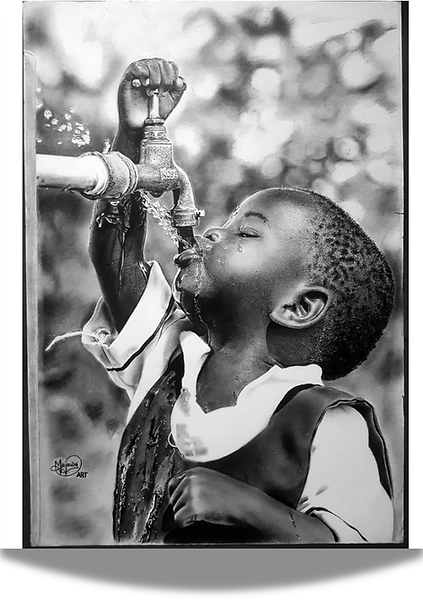
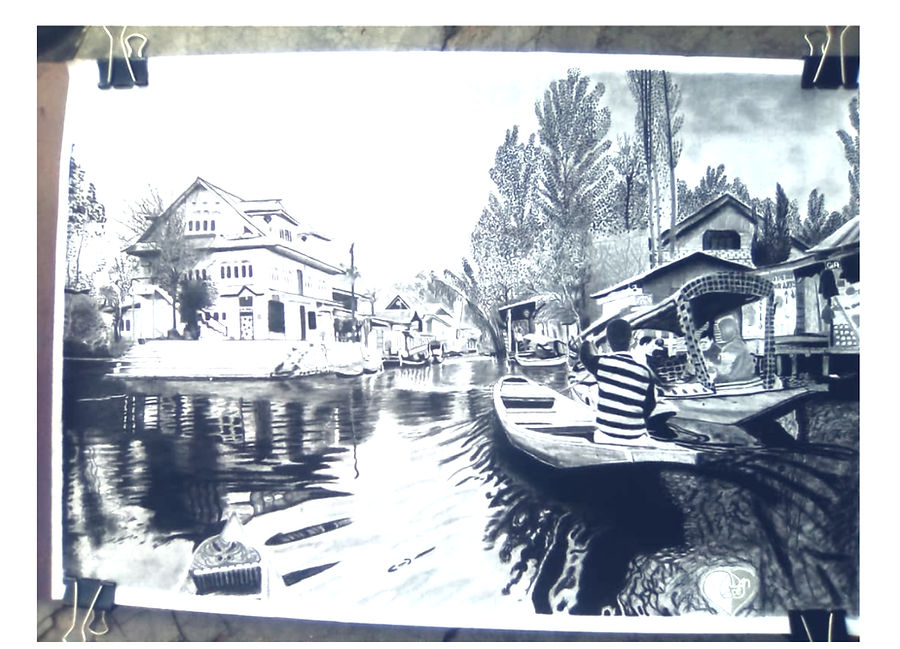
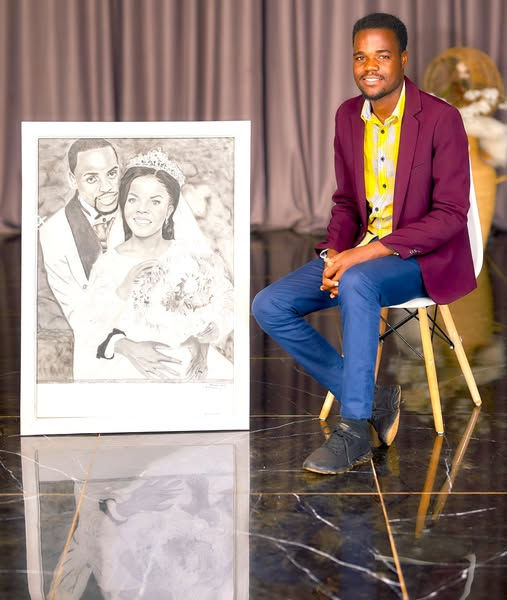
Kumbukani Chawinga is a pencil artist, poet and a violinist from Malawi.
It Is Not Over Until Ralia Loves Me
Published June 30, 2026
The first time Bashir saw Ralia, the harmattan wind was blowing dust through the streets of Hadejia like forgotten prayers. The town was alive with the usual evening sounds—children chasing old bicycle tires, traders folding their mats in Kasuwar kara market, and the distant echo of the Maghrib adhan rising softly from the mosque near the riverbank.
Ralia stood beside her mother at a fabric stall, adjusting the edge of her blue veil as the wind fought against it. Bashir had gone there to deliver bags of rice for Alhaji Maikudi, the wealthy merchant he worked for. But the moment he saw her face, everything else disappeared.
Not because she was the most beautiful girl in Hadejia—though many said she was—but because sadness already lived in her eyes.
“Who is she?” Bashir asked quietly.
His friend, Nura, laughed. “Kai, Bashir. That is Ralia, daughter of Alhaji Balarabe. Forget her. Girls like that do not marry boys who carry rice under the sun.”
But Bashir could not forget her.
From that day, he began searching for reasons to pass through her street. Sometimes he would see her fetching water with other girls in the early morning. Sometimes he saw her standing outside their compound after isha, greeting elderly women respectfully.
“Assalamu alaikum, Hajiya,” she would say softly.
And every time Bashir saw her, something inside him tightened.
He was poor, yes. His father had died years ago, leaving him to care for his sick mother and two younger sisters. He never finished secondary school because survival became more important than education. Yet his heart carried dreams too large for his pocket.
One evening after Isha prayer, Bashir gathered courage and approached her near the narrow dusty path behind the mosque.
“Ralia,” he called gently.
She turned slowly, startled.
“I know this may sound strange,” he said nervously, “but I have carried your image in my heart for many months.”
Ralia lowered her eyes immediately.
“People are watching,” she whispered.
“I do not fear people.”
“But I do,” she replied.
Still, she did not walk away.
That small moment became the beginning of their secret love.
Days turned into months. Bashir would wait for her near the old neem tree after evening lessons. Sometimes they spoke only for a few minutes before she hurried home. Other times, they shared long conversations beneath the pale moonlight of Hadejia skies.
Ralia loved the way Bashir listened carefully whenever she spoke. He loved the softness in her voice whenever she said his name.
“Bashir,” she once told him, “my father will never accept this.”
“Then I will work harder,” he replied quickly. “I will become somebody.”
“You do not understand my family.”
“I understand love.”
Ralia smiled sadly.
In Northern towns like Hadejia, love alone was rarely enough.
Her father, Alhaji Balarabe, was respected across Jigawa. Wealthy cattle owners greeted him with deep respect. Politicians visited his compound during elections. His daughters were expected to marry men of status, men with cars, lands, and family influence.
Not boys who smelled of sweat and rice dust
When rumors of Bashir and Ralia began spreading through the community, her mother became worried.
“Ralia,” Hajiya Balarabe warned one evening, “people are talking. A girl’s dignity is like an egg. Once broken, it cannot be repaired.”
Ralia remained silent.
Then came the day everything changed.
A wealthy businessman from Kano, Alhaji Musa Dantata, arrived seeking Ralia’s hand in marriage for his son, Sadiq. The family celebrated immediately. Women filled the compound with laughter and congratulations.
But inside her room, Ralia cried until dawn.
When she finally met Bashir near the riverbank, her face looked empty.
“They want me to marry Sadiq,” she whispered.
Bashir stared at her as if the earth had cracked open beneath him.
“No.”
“My father has agreed already.”
“Then tell him you love me.”
“You know I cannot.”
“Why?”
“Because I am his daughter.”
Bashir’s voice broke. “And what am I?”
Ralia’s tears rolled silently.
“You are the only thing my heart ever chose.”
For weeks, Bashir fought desperately against fate. He worked day and night, carrying goods, repairing bicycles, even traveling to nearby villages searching for extra work. He wanted money, dignity, something worthy enough to stand before Alhaji Balarabe.
But poverty is cruel. The harder he ran, the more it mocked him.
One afternoon, he finally gathered courage and visited Ralia’s father.
The compound was large and quiet. Goats wandered near the entrance while elderly men discussed politics beneath a mango tree.
Alhaji Balarabe listened coldly as Bashir spoke.
“I love your daughter,” Bashir said carefully. “I may not have wealth now, but I am hardworking. I will spend my life making her happy.”
The old man looked at him for a long moment.
Then he laughed softly.
“Young man, love does not feed a family.”
“I can work.”
“You can struggle,” Alhaji corrected. “My daughter was not raised for suffering.”
Bashir swallowed painfully.
“Please, Alhaji.”
“No.”
That single word destroyed something inside him.
The wedding preparations continued quickly. Drummers arrived. Tailors moved in and out of the compound. Women sang traditional songs late into the night.
Meanwhile, Bashir disappeared from public gatherings. He stopped joking with friends. He stopped playing football near the school field. Even his mother noticed the silence eating him alive.
One rainy evening, Ralia secretly came to see him.
He sat outside his small house under a leaking roof, staring into darkness.
“Bashir,” she called softly.
When he looked at her, his eyes were red from sleepless nights.
“I came to say goodbye.”
He shook his head slowly. “No. It is not over until Ralia loves me.”
She began crying immediately.
“I already love you.”
“Then stay.”
“You know I cannot.”
“Then run away with me.”
Ralia stepped backward as though slapped.
“You want me to shame my family?”
“I want you to choose us!”
Silence fell heavily between them.
Then she whispered the cruelest truth.
“In our world, Bashir… love is not always enough.”
The wedding took place three days later.
The entire town celebrated. Expensive cars filled the streets. Bright fabrics danced beneath the afternoon sun. People praised the union between two respected families.
But Bashir stayed hidden inside his room.
That night, while wedding drums echoed through Hadejia, Bashir walked alone toward the river outside town. The rain had started again, soft and endless.
Nobody saw him except an old fisherman passing in the dark.
The next morning, they found Bashir’s sandals near the riverbank.
His body appeared two days later.
Hadejia fell silent with shock.
Even the market women spoke in whispers.
Ralia heard the news while sitting beside her new husband’s family. At first, she refused to believe it. Then someone mentioned the river.
She collapsed immediately.
For many years afterward, people still remembered Bashir.
Some said he was foolish for dying because of love. Others blamed poverty. A few blamed Ralia.
But every rainy season, when the river overflowed and the wind carried dust through Hadejia again, old people remembered the boy who loved beyond reason.
And inside a large house in Kano, Ralia sometimes woke at night hearing his voice one final time:
“It is not over until Ralia loves me.”
But by then, it already was.


9. Short Fiction by Musa Bin Imran Al-iqitisady
Musa Imrana was born in the city of Hadejia, Jigawa State of Nigeria, He had his primary Education at Jama'are Islamiyya Primary school from 2008 to 1014 and high school Education at Senior Secondary School Shagari. He is currently an undergraduate student of Economics in Sule University Jigawa State. He is Hausa. He has engaged himself in many activities of diverse aspects, such as informal education, local occupation and lot more.
10. Two Poems by Chidebelu Emmanuel Nnazoba
The Witness
The vulture is hated
for honesty.
He eats what the feast denies,
cleans what pride perfumes.
The village calls him filthy
while dining on decorated rot.
The outcast tends
what polite mouths bury.
He handles the carcass of truth.
For this,
the perfumed accuse him.
Decency is often deodorised decay.
The moth reads garments
better than priests.
It finds the weak thread
in the robe of honour.
The clan wears seamless belonging
stitched from slogans,
patched with ritual.
He notices the tear.
Worse—
he touches it.
No society forgives the hand
that proves the fabric mortal.
The many weighs worth
by what glitters.
He measures absence—
missing grain,
missing truth,
missing soul.
Such knowledge is outlawed.
The crowd can pardon vice
but not revelation.

11. Chidebelu Emmanuel Nnazoba
Not Our Kind
He came where stones keep counsel—
not as guest, but question.
The market asked for name, clan, price.
He paid in silence.
For markets trade in echoes;
Silence closes accounts.
They asked the river’s source.
He pointed to thirst.
Thus the crowd concluded:
not our kind.
They fenced him with names:
alien, omen, error.
Name refused him;
he became presence.
Unlicensed presence
unsettles the licensed.
The tribe trusts what can be buried:
bones, titles, fathers.
What escapes record
is called danger.
He spoke nothing.
Yet silence accused.
The crowd fears no stranger—
only the mirror
that will not flatter.
He was that mirror:
no sermon,
only an unpurchased gaze.
Thus the verdict came:
not our kind.
But earth knows no stranger.
Root asks for no passport.
The market: danger.
The earth: witness.
Between those judgments
stands every exile.
Where dust outranks blood,
he is no stranger—
only witness.
Chidebelu Emmanuel Nnazoba, known as Deb Angel, is an Igbo-born Nigerian metaphysical poet whose satirical and reflective poetry explores society, identity, and human contradictions through humour, irony, and philosophical depth.
12. A Poem by Peter Chukwuka Ezeh
What Do They See When They Look at Me?
A reminder of life’s frailty, a symbol of the old,
Like a hearth used but now cold,
of a story told without lustre.
What do they see when they look at me?
A roaring gust of confusion, a dynamite,
filled with close-up wall of destiny, short dreams, easily fulfilled, a depiction of a typical teenager,
Reckless abandon personified, a sleepy dreamer, like the livestock, in Jesus’ manger,
a hero of thought, a king of the dreamland.
What do they see when they look at me?
A shadowy figure cloaked in hateful spite,
a force of nature, revenge's delight,
tick-tock the clocks tick, as I plot my revenge, plots thick,
A smiley face, forgiving and benignant, a face that beckons "bully me, would you",
swollen cheeks, swollen eyes, swollen stomachs, the songs of midnight aches.
A little genius, the devil's spawn.
A little demon who pays back in the day's dawn
What do they see when they look at me? I do not know.
What do they see when they look at me? Can die in a dusty room from death’s own rope.
In a twirling world of uncertainties,
in a world of deception, and standards of many quantities.
In a world where the lamb is adored, and the lion feared,
both put in a cage, the sheep for the lion reared?
I do not seek the unseemly praise of feeble consciousness,
nor the tempting lure of patterned speech, fancy and flavoured, filled with maliciousness.
Now? I bring a mirror to the halls of men, and in the limelight, when they look upon me, what do they see?
They see a sort of resemblance, the very epitome of their being,
Filled with hate, envy, and pride, with a touch of what could have been.
No longer a crystal visor to see through.
What do they see when they look at me?
Frankly, I do not care.

Peter Ezeh is a Nigerian student who writes poems and fiction. A longtime author of unpublished works, he is drawn to mystery, melancholy, and the quiet complexities of human emotion, crafting stories and verses that linger long after the final line.
13. A Poem by Halima Raji (Published in The Razor Wire of Exile)
The Girl Who Asked for a Pen
For Aisha, and every daughter like her
At ten, I knew the weight of a book—
not the Qur'an board, but a story with pictures.
My mother laughed: “Debbo ndoggu? A debbo?”
But she tied the yellow scarf—a gift for my tenth birthday—
the blue dress blooming like a small sky.
I wore it fetching water, grinding millet,
pretending the hem was a blackboard.
At twelve, I whispered to Baba: “School.”
He spat. “Pulaaku is your school.
Modibbo teaches boys. You learn to knead, to birth.”
My sisters’ eyes like dry wells,
no alkalam in their fingers—only firewood.
At fourteen, a man came. Sixty-five.
His smile—a cave of goro-stained teeth.
He laughed like a donkey coughing.
“She will do,” gripping my wrist—
the hand of a man never told “no."
The wedding was small. Men nodded,
their laughter stones in a metal bowl.
Women sullen-faced, wrappers tight as sealed lips.
I wore my yellow scarf and blue dress—
the only brightness in that room.
My mother did not weep. She had wept once, for herself.
He whisked me off on a donkey before sunset.
No romance. Just goro on his breath
and a hut with a low door.
Now I am a mother of six.
The youngest—her collarbones like question marks.
At night, I trace letters in the dust: One, two, three.
I teach her. She will not wear a yellow scarf to an old man’s hut.
I vow that: my children will attend school.
Especially her, the fragile one.
Let them call me nyiɓe—rebel.
A mother with a pen is more dangerous
than any old man with goro in his teeth.

Halima Raji writes about the inner worlds of African girls for whom a classroom is a dream, and a dowry is a destiny. Her work explores how tradition, poverty, and gender collide to close school doors—and how the desire to learn survives in whispers, in folded cloth, and in mothers who refuse to pass on the same sentence. She believes poetry can hold both the wound and the vow.
14. A Poem by Denoo Edinam Yawo (Published in The Razor Wire of Exile)
Stranger Danger
This body. spacious. empty.
I have filled with music.
The music now, in the empty space,
rejecting the contours of aloneness, has baptised me into God,
now with his hands,
me, closer to him than he is in this body, has tuned
the music into/crumpled milk leaking/from my right/
breast,
has turned
the diagnosis into/corvette tyres scraping/ against the white/
the black ink sashaying/ like a bullet trespassing/ against the will of a body.
I, now God, look for
the damp spaces between/the doctor’s hesitant words, find/ the opening and
j
u
m
p
into the orange areola, fill the lactiferous ducts, with stale foreign prayers, command
macrophages to
engulf native tongues into memory. The thoracic walls echo with mutations.
They beckon for answers into an open
q
u
e
s
t
i
o
n:
when did you first notice the symptoms?
on a scale of one to ten, with indifference between the answer to your prayer,
is God residing in this breast still?
The scalpel is a lighthouse/excising God of small glory/, into a petri dish/
waiting for the end to come.

Denoo Edinam Yawo is a Ghanaian poet/writer whose work delves into themes such as the body, the politics of language, spirituality, and faith at the intersection of living. She is a 2025 Black Atlantic Residency Fellow, an alumna of the 2025 CAINE Online Editing Program, and the 2025 Johannesburg Institute of Advanced Studies (JIAS) Creative Writing Workshop for Emerging Writers. She is the winner of the New Voices Poetry (2025), the 2024 Second Runner Up and the 2025 First Runner Up of the Adinkra Poetry Prize. Her work has appeared in or is forthcoming in Rowayat, Tampered Press, New Coin South African Poetry, Kalahari Review, and elsewhere.
15. A Poem by Dr T. Dallas Saylor
LOVELAND
On the hardwood floor I respond with reaching. Tell me about the stall in the club’s bathroom, the way you pinned his knight to the white queen, lipstick running down the bottle after class. Takes, takes, gets captured: the pawn breaks in the wrong bed, stains satin sheets. You dab white-out on the side of the fridge, draw a win & a shot. I love love that hangs, ruffles the muzzle. I could almost hike the suburbs with you, resetting your bare stomach, my 3D crotch, to the first fireball, the spare green spirit. In photo booths he chokes on yes, another. He shoves the pieces in pen cases, jamming the base of the rook with his thumb like a slug that just won’t load, piece o’ shit. How a young man sweats after sex, his two fists running off to Loveland, & laughs like a face-painted clown.

Dr T. Dallas Saylor (he/they) is the author of three poetry collections: Starfish (Glass Lyre Press, 2025), Holy Little Masochisms (Pen & Leaf Press, forthcoming 2027), & Dragon Year (Word Works, forthcoming 2027), & his work is on Twitter: @dallas_saylor.
16. Featured Creative: Etete Otuokon
The Ghost of My Beyond
Every night, my soul reawakens —
and he, the other me, smiles wider than I ever can.
He is lighter.
Freer.
Whole again.
Because she is there.
Waiting for him.
The one I lost.
The one I cannot stop seeing.
In my dreams, she still remembers my name.
Her hands still fit mine
like promises never broken.
Her voice still calls me love —
and every time,
I fall for the lie of the dream.
But when I wake,
my room is cold.
My bed is wet
with the tears shed for my ghost
I don’t even remember crying.
And I realize —
I’ve lost her all over again.
This has been going on for months.
I pray until my knees ache.
I fast until my body trembles.
I sit across from therapists who nod
and tell me time heals all wounds.
But time only feeds the dream —
makes it sharper,
crueller.
And I can’t tell anyone.
How could I?
They’d say I sound weak,
pathetic — obsessed even —
but it’s not obsession,
it’s invasion.
It’s not my doing.

'Do What I Want,' (below) is Otuokon Etete's first music video.

I was digitally introduced to the artist and below is a transcript of our interview.
Tell us about yourself in a few words please.
I am a writer from Nigeria, but I am a poet first and foremost. I do not enjoy mundane living; I believe life is meant to be lived properly. I enjoy writing stories, poems, and music. I sometimes struggle with opening up, but these creative mediums help me pass my message across.
What inspired your latest single: ‘Do What I Want?’
I was inspired to write "Do What I Want" because for most of my life, I had been doing exactly what I was told to do by others. This song is a declaration that I want to live for myself now.
What genre of music is that please?
The genre is Melodic Rap / R&B.
How does poetry writing influence your song writing?
"For me, music is simply poetry with a voice and a beat behind it.
Because of my poetic background, both my poems and my songs naturally lean into a very nostalgic, emotional, and reflective depth."
Do you set most of your poems to music?
No, I do not set most of my poems to music. I have two distinct sides to me—the poetic side and the musical side. But at the end of the day, it is all art, and I love both.

Etete otuokon is a poet, songwriter from Nigeria. He battles mental health issues, and he is the result of a toxic household. When he writes a piece, he feels alive and he wants to live again.
Poetry allows me to live.
- Etete aka ScarFaceCappy
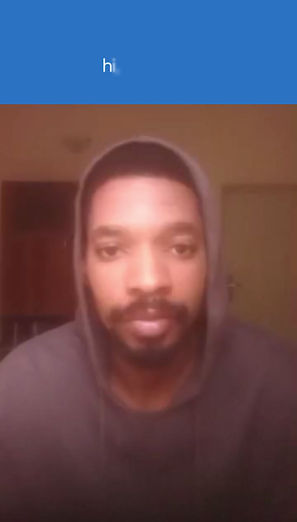
17. A Short Review of BRETT ANDERSON’S Poem: ‘What Privilege,’ published in The Razor Wire of Exile (2026)
Brett Anderson’s “What Privilege," opens with a satirical interrogation of race and class, where assumptions about social hierarchy are quietly destabilised. I am drawn to how the speaker repeatedly resists the idea of privilege even as the poem carefully reveals how deeply embedded it is in his everyday life. The poem’s rhetorical persona is established early through repetition. The recurring use of “hoping” in lines such as “hoping someone will notice me,” “hoping someone will throw

the ball to me,” and “hoping someday there’ll be call to me” conveys a figure who sees himself as marginalised and overlooked. Yet this apparent vulnerability is gradually undermined by the poem’s later revelations of wealth, land ownership, and social power. Anderson uses repetition not only to create rhythm but also to construct a self-pitying character whose claims become increasingly ironic. This tension is handled with control and subtle humour, which allows the critique to develop through antithesis rather than assertion. The result becomes a narrative perspective that feels both conversational and revealing, drawing the reader into complicity with its limitations. Anderson’s use of colloquial language further strengthens this satirical tension.

By CHUKWUEBUKA ONYISHI, Poetry Editor,
Penned in Rage Journal (Pictured)
Photo: Poet, Brett Anderson
The non-literal question, “What privilege?” delivered “with an entitled chuckle,” captures the poem’s central identity. The casual, conversational tone also suggests honesty and immediacy, even when the word “entitled” clearly exposes the very privilege the speaker attempts to deny. This juxtaposition between denial and exposure allows the satirical tensions to emerge organically from the speaker’s own language rather than from overt authorial judgement. The poem’s social setting is reinforced by its use of names—Phumeza, Chibale, Tinashe, and Cebile—which lend specificity to the daily labour and economic relationships being depicted. These details support its portrayal of social hierarchy and power. Anderson’s linguistic choices also extend to its visual and typographic style. The consistent use of lower-case “i” contributes to the informal, self-effacing tone of the persona, even as the speaker describes possessing “all the money,” “all the land,” and “all the positions of power.” This visual humility contrasts with the magnitude of authority being described by deepening the poem’s ironic structure and reinforcing its critique of privilege.

What Privilege
by Brett Anderson
seven percent of the people in my land look like me
so I must be standing somewhere on the fringes, right?
hoping someone will notice me
hoping someone will throw the ball to me
hoping someday there'll be a call to me
hoping against hope some chips will fall to me
just a lonely little leaf drifting along
on this torrential wave
feels strange then that when I lift my hand to my head
it feels like i am the one wearing the crown
that when the majority dare to lift their eyes
to take a glimpse of me
they’re looking up, not looking down
that i, or people who could be mistaken for me
have all the money
and all the land
and all the positions of power
eating out of my hand
“What privilege?” i ask, with an entitled chuckle
as Phumeza passes me my morning coffee
before continuing with her job of cleaning my house
I think of the ridiculousness of it all
as I cast my eye on Chibale through the window
who is busying himself in my garden
making sure everything is neat
i am entitled to spend time thinking about that question
as Tinashe (God is with us) fills my car with petrol
not thinking for a second that he will never own
any one of the vehicles he dutifully feeds
for just about enough money
to spill some scraps on to the dinner table
and it starts to gnaw at me
so much so that i miss the greeting from Cebile (rich)
as she packs my luxury coffee and leg of lamb into separate bags
to make enough for her family to enjoy some beans tonight
‘how dare they accuse me of privilege’
i am right angry now
as I dive into my socials to make my wrath known
but all this has made me quite tired
and so I flop down on to the couch and reach for the remote
Author's Bio
Brett "Fish" Anderson is a writer, improvisor, speaker, and poet, but above all tries to be a lover of God and people, trying to spend his life becoming a better version of himself and motivating others to work to make the world a better place for everyone who lives in it. He is the author of two books, one of which is a Poetry collection titiled: Not water, JUST ICE! available at https://www.amazon.co.uk/water-JUST-Brett-Fish-Anderson/dp/1049209419
*What Privilege might be a play on the expression: white privilege.
18. Musician Tamba Johnson
Tell us about yourself
I'm Tamba S. Johnson. My stage name is Yaanie. I'm a Liberian Sierra Leonean. My father is from Liberia, and my mother is a Sierra Leonean from Kailahun district kissy Teng chiefdom My father is from Lofa County. I sing and rap in my native languages are Kissi, Liberian Koloqua, Krio and English.
How do you use your music to represent your community?
I use my music to educate my people and to speak about our daily lives, struggles, our culture and traditions. I'm not making much money from my music. But I'm not discouraged about that I keep pushing still.
